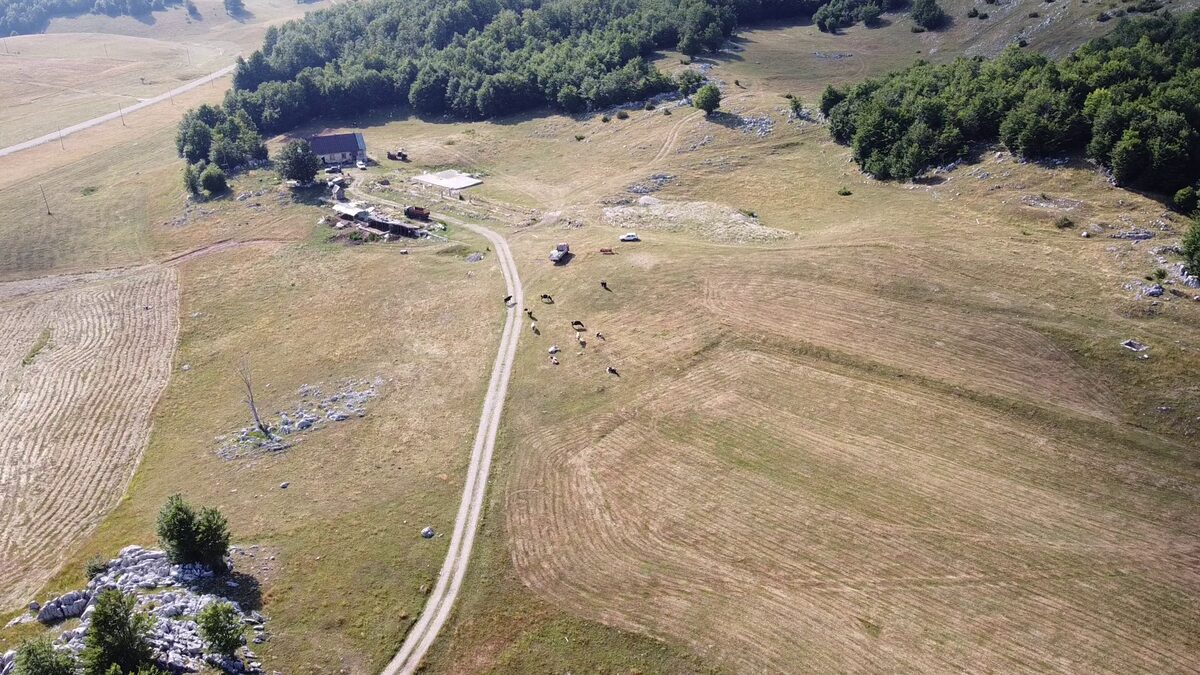
Montenegro's mountain meadows and pastures suit cattle, sheep, hay and bees, and farming them comes with generous support. A registered farm can claim annual national support, and EU grants under the IPARD program pay 50% to 75% of the eligible cost of farm buildings, machinery, equipment and food processing, depending on the measure and the applicant. Buying the land is not covered, but much of what it takes to turn a holding into a working farm can be.
Meadow, pasture and class
Montenegrin land records distinguish livada, or meadow, from pašnjak, or pasture. Each parcel also carries a cadastral class reflecting its natural and economic conditions for production. Read the record alongside the parcel plan, then walk the land to check machine access, scrub and the condition of the grass. The class is a guide, not a forecast of the hay yield.
Grazing at 1,400 meters
At around 1,400 meters the farming year follows the seasons: summer grazing on the high pasture, hay cut from the meadows, and winter feed and shelter for the animals. Ask about the usual turnout and hay-cutting dates, where hay is stored and how winter feed reaches the holding. Budget from the start for water, corrals, fencing and someone to check the livestock.
Cattle and sheep fit the region's katun tradition: seasonal shepherd settlements where milk becomes cheese and skorup, also called kajmak. National support backs this way of farming. The 2026 Agrobudget's mountain-pasture measure supports farms that keep at least four livestock units on Montenegrin katuns for at least three months, among other conditions. Set the stocking rate from the grass, water and grazing rotation rather than from the support threshold. Bees are another good fit for mountain meadows, once forage, exposure and access to the hives have been assessed.
Register the farm first
Registration in the Register of Agricultural Holdings is free, open all year and the key to every kind of support. Family farms and companies can both register. You need agricultural activity involving land or animals, and a company supplies its business-register extract and evidence that it owns or lawfully uses the declared land.
Register as soon as you start farming and claim national support from the first season. Under the current rules, some IPARD measures, including processing on the farm and rural tourism, require established entitlement to farm support before a call is published, so an early start keeps those doors open.
A Montenegrin company that owns the land can also be the registered holding and the grant applicant. The rules include registered agricultural companies among possible applicants, and nothing in them limits IPARD to Montenegrin citizens. If your company has foreign shareholders, ask the IPARD authority to confirm eligibility for your measure in writing. The foreign buyers guide explains the company route.
EU grants through IPARD
IPARD, the EU's Instrument for Pre-accession Assistance for Rural Development, helps candidate countries modernize farms and rural businesses as they prepare for membership. Montenegro's agriculture ministry runs it locally. For the main investment measures, the EU funds 75% of each grant and Montenegro the other 25%.
Applying follows a clear sequence. The ministry publishes a call, you apply with your project, and successful applicants sign a grant contract. You then buy the approved equipment or carry out the work, submit a payment claim and receive the grant after the checks.
Montenegro has a strong record with the program. Under IPARD II, which ran from 2018 to 2024, 748 projects received €46.4 million of public support, backing €77.7 million of completed investment, and 650 of them were farm investments. The current program, IPARD III, is bigger: about €82 million of public money, €63 million of it from the EU, expected to support around €128 million of investment.
What the grants pay
Grant rates apply to eligible costs, excluding VAT:
- Farm investment (Measure 1): projects of €10,000 to €650,000, standard grant 60%.
- Processing and marketing (Measure 3): €30,000 to €2 million, 50%.
- Processing on the farm (Measure 7.2): €10,000 to €30,000, 60%.
- Crafts (Measure 7.3): €5,000 to €15,000, 60%.
- Rural tourism (Measure 7.1): guest rooms and dining on farms, covered in agritourism grants in Montenegro.
Higher rates are available. Farm investment rises to 65% in mountain areas and 70% for qualifying young or organic farmers, up to a ceiling of 75%. The higher rates do not simply add together. Processing projects get extra support for wastewater, waste use and renewable energy, and qualifying collective investments reach 70%. Under Measure 7, qualifying young farmers, certified organic producers and collective investments get 70%, again with a 75% ceiling.
For a mountain holding, the 65% mountain-area rate is the first one to ask about. Each call lists the activities and costs it covers, so confirm the rate for your own category and items before you budget.
Farm investment: Measure 1
Measure 1 is open to registered agricultural holdings, recognized producer organizations, cooperatives and qualifying aquaculture businesses. It covers livestock, dairy, crops, fruit and vegetables, vineyards, olives and beekeeping.
The minimum sizes are modest. The first IPARD III farm call gave examples such as five dairy cows, half a hectare of fruit or outdoor vegetables, 0.1 hectares of vegetables under cover or 30 bee colonies. New entrants who start smaller can, under specified exceptions, reach the required scale by the first phased or final payment, with extra registration and ownership conditions.
You also need the relevant qualifications, experience or training, and a business plan: a simplified one below €50,000 and a detailed one from €50,000 up. New farm buildings must include renewable energy, so design it in from the start. Some investments can be made on land or premises leased for at least seven years. The young-farmer rate is for farmers under 40 who run the holding and have the required skills. A young shareholder alone does not qualify a company.
From milk to cheese: processing
Turning milk from the katun into cheese and kajmak on the farm fits Measure 7.2. It supports processing linked to a holding, with projects of €10,000 to €30,000 at 60%. The farm needs to be registered, hold the required food-business status and already have a record of farm support before the call is published.
Larger dairies and food businesses use Measure 3, which supports registered processing businesses, cooperatives and producer organizations, generally small and medium-sized. Projects must meet food-safety, environmental, animal-welfare and workplace standards. Equipment installed in leased premises can qualify; the first processing call required a lease of at least ten years for its equipment-only route.
Planning the cash flow
The grant is paid after the investment, so the cash you need while the work is under way is larger than your final share. Take a project with €100,000 of eligible costs at 60%:
- The grant is €60,000 and your final share is €40,000.
- You can ask for an advance of up to half the grant, here €30,000. It must be backed by a bank guarantee for 110% of the advance (€33,000) that stays valid until six months after the completion deadline.
- With the advance, you still finance €70,000 until the grant is paid. Where payment in up to three installments is allowed, the gap shrinks sooner.
- VAT, costs outside the grant, interest and any overruns come on top.
The Development Bank of Montenegro offers a dedicated IPARD loan at 4.5% a year, or 4.0% for qualifying projects in northern or less-developed municipalities. It is repayable over up to 12 years, with up to four years' grace and a 0.2% processing fee. Rates can change, and the bank assesses repayment capacity and security. Businesses less than a year old that borrow more than €50,000 may need extra guarantees, a deposit or a guarantor. Arrange the loan and the grant together.
The grant does not pay for buying land or existing buildings, rent, used equipment, ordinary running costs, interest and guarantee charges, your own labor, routine maintenance or VAT. VAT and customs exemption certificates exist for IPARD projects, so settle the tax treatment with your accountant before the first invoice.
The rules once you apply
- Wait for the contract. Starting work or signing contracts with suppliers or builders before the grant contract can disqualify the project. Quotes for the application are fine, and some preparation costs are allowed.
- Buy at arm's length. Use the current procurement forms, independent suppliers and reasonable prices. Family, ownership or partnership links with a supplier create a conflict of interest. Get approval before changing the project.
- Expect ranking. When applications exceed the budget, projects are ranked, so meeting the conditions does not guarantee an award. The same cost cannot be funded twice.
- Keep the investment. It must stay in its approved use for five years after final payment, and the accounts must be kept for at least seven years. Bear this in mind if you might sell or restructure. Combined support is capped at €3 million across measures and across IPARD II and III.
Calls and what comes next
The ministry publishes each call on its IPARD portal with the eligible sectors, costs, ranking criteria, deadlines and forms. Calls usually stay open for about 60 days, so have the farm registered and the plan ready beforehand. A notice titled "poziv za dostavljanje ponuda" asks suppliers to quote for an existing IPARD project. It is not a new grant call.
IPARD III's programming period ends in 2027, and projects can be paid until the end of 2030, so the program still has years to run. Contracting can take months, so choose suppliers whose prices will hold and leave room in the opening date. Further measures for agri-environment and organic farming, LEADER local development, rural infrastructure and forestry open as the ministry is approved to run them.
Further ahead, EU accession would bring Montenegro into the Common Agricultural Policy. The European Commission has proposed at least €277 million of farm support for Montenegro from 2028 to 2034, rising from €28.6 million in 2028 to €54.3 million in 2034. The figures are provisional and depend on accession, so keep them out of the budget. They point to more support for Montenegrin farming, not less.
Before you buy
- Match the measure to the plan. Livestock, hay, bees, processing and tourism each have their own measure and rules.
- Check the applicant. Registration, qualifications, business size and support history.
- Check the land. Ownership or lease, cadastral details, building requirements and location.
- Build the budget. Keep the purchase and other excluded costs separate from the eligible investment. Show the most cash you will need before the grant arrives and how you will finance it.
- Ask in writing. Send the ministry your activity, applicant structure, farm history, municipality and parcels, investment amount and financing, and ask for written answers on eligibility before you commit.
Where woodland forms part of the farm, budget separately for private forest management.